
Top Pressure Valve Manufacturers How to Choose?
Choosing among top pressure valve manufacturers requires more than comparing prices, catalogs, or familiar brand names. A pressure valve may control steam, water, gas, or aggressive chemicals under demanding conditions. Its performance depends on materials, pressure ratings, temperature limits, sealing quality, and installation accuracy. A polished website cannot prove long-term reliability.
This guide examines how experienced buyers evaluate manufacturers before placing an order. It considers certifications, factory testing, inspection records, production capacity, and after-sales support. Clear documentation matters, especially when engineers must verify traceability or replace a valve years later. Practical details also reveal quality. Look for clean machining, consistent markings, protected threads, and packaging that prevents damage during transport.
Application knowledge is equally important. A valve designed for clean water may fail in high-temperature steam service. A low-cost model may create expensive downtime. Speaking with technical staff can expose whether a manufacturer understands pressure loss, corrosion, cycling frequency, and maintenance access. Field feedback from operators often tells a different story than laboratory claims.
No selection method is flawless. Even respected manufacturers can offer unsuitable products for a specific system. Therefore, the final decision should balance verified performance, engineering support, delivery reliability, and total operating cost. The strongest choice is not always the most famous name. It is the supplier that can consistently match its pressure valve to real operating conditions.
What Defines a High-Quality Pressure Valve Manufacturer?
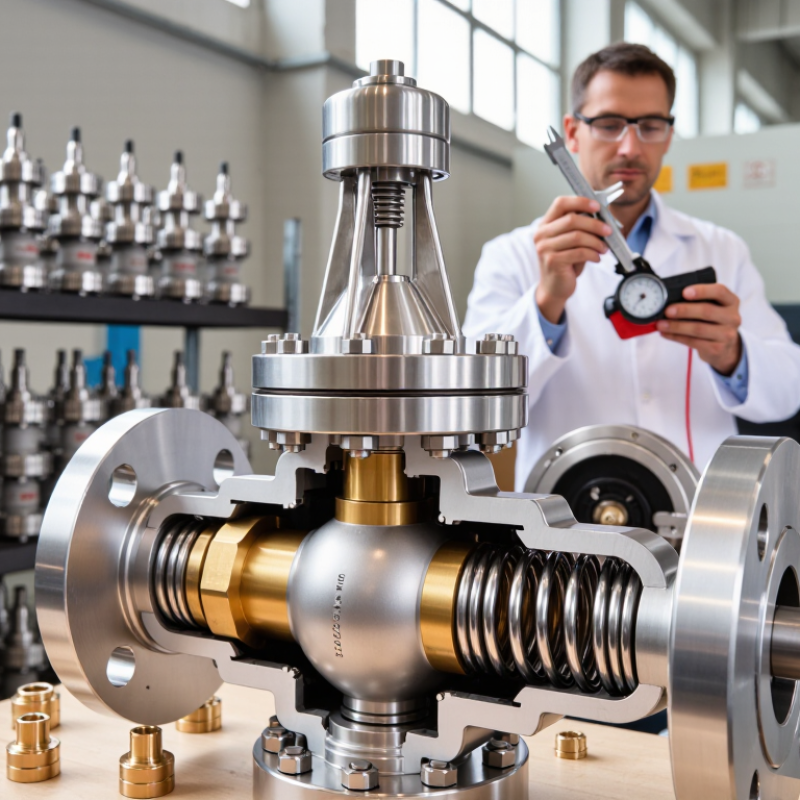
A high-quality pressure valve manufacturer proves performance before discussing price. Grand View Research valued the global industrial valves market at about USD 78 billion in 2023, with steady growth expected through 2030. This scale increases competition, but market size does not prove engineering competence. Buyers should request design calculations, pressure-temperature ratings, and documented material traceability for every critical component.
Look for testing that follows recognized requirements, such as API 598 or ISO 5208 for leakage testing. Ask for hydrostatic test records, calibration certificates, and inspection points with clear acceptance criteria. A reliable manufacturer can identify the steel heat number stamped on a valve body and connect it to mill certificates. It should also explain how spring settings, seat materials, and corrosion allowances suit the actual service. Good documentation is practical evidence.
Experience matters when conditions change. An experienced supplier may review pulsation, thermal cycling, installation orientation, and maintenance access instead of accepting a basic specification blindly. ISO 9001 certification supports process control, but it cannot replace witnessed testing or technical judgment. I would be cautious of suppliers promising zero leakage in every application; that claim needs context. Even strong factories can produce defects, so independent inspection and sampling remain worthwhile. Sometimes the uncomfortable question is the most useful one: what happens when the valve fails?
Top Pressure Valve Manufacturers How to Choose? - What Defines a High-Quality Pressure Valve Manufacturer?
| Evaluation Dimension | What a High-Quality Manufacturer Should Demonstrate | Relevant Technical Reference or Benchmark | Evidence Buyers Should Request | Why It Matters |
|---|---|---|---|---|
| Applicable Standards | The manufacturer selects standards according to valve type, service conditions, pressure rating, installation location, and destination market. | Common references include ASME B16.34 for valves, API 6D for pipeline valves, ISO 5208 for pressure testing, and EN 12266-1 for industrial valve testing. | Applicable standard list, product datasheet, design calculations, and a statement of conformity where required. | Standards provide a consistent basis for design, testing, documentation, and performance comparison. |
| Pressure and Temperature Rating | Published pressure-temperature ratings match the selected body material, trim, connection type, and operating conditions. | Ratings should be verified against the applicable pressure-class or PN-class tables and the material temperature limits. | Pressure-temperature chart, valve marking, material specification, and design pressure and temperature confirmation. | A valve must safely contain the process fluid throughout the full operating range, including foreseeable transients. |
| Body and Trim Materials | Materials are selected for pressure, temperature, corrosion, erosion, fluid compatibility, and required service life. | Material grades should comply with the applicable ASTM, ASME, EN, or equivalent material specification. | Material certificates, heat numbers, positive material identification records, and corrosion-compatibility information. | Correct material selection reduces leakage, corrosion damage, premature wear, and unplanned replacement. |
| Pressure Testing | Every finished valve undergoes documented shell and seat or closure testing using an approved procedure. | ISO 5208 and EN 12266-1 define commonly used industrial valve pressure-test methods and leakage classifications. | Test procedure, test medium, test pressure, duration, acceptance criteria, calibrated gauge details, and signed test report. | Testing verifies pressure containment and closure performance before the valve reaches the installation site. |
| Leakage Control | The manufacturer clearly states the allowable internal and external leakage level for the valve design and service. | ISO 5208 leakage rates or an explicitly agreed project specification should be used for acceptance. | Seat-leakage report, stem-seal details, fugitive-emission test results where applicable, and repair records. | Controlled leakage improves safety, reduces product loss, and helps meet environmental and process requirements. |
| Design and Engineering Capability | The manufacturer can evaluate flow direction, pressure drop, cavitation, water hammer, actuator loads, thermal expansion, and emergency conditions. | Engineering calculations should follow the applicable valve, piping, pressure-equipment, and process design requirements. | Approved drawings, sizing calculations, finite-element analysis where necessary, and application review records. | Sound engineering prevents incorrect sizing, unstable operation, excessive noise, and mechanical failure. |
| Manufacturing Traceability | Critical components remain traceable from raw material receipt through machining, assembly, testing, and shipment. | EN 10204 inspection documents, often including Type 3.1 certificates, may be specified for metallic products and pressure-retaining parts. | Heat-number traceability, inspection plans, traveler records, dimensional reports, and final release documentation. | Traceability supports quality investigations, regulatory compliance, and reliable replacement-part selection. |
| Quality Management System | A documented quality system controls design changes, purchasing, production, inspection, nonconformities, and corrective actions. | ISO 9001 is a widely recognized framework for quality management systems; certification scope should cover relevant activities. | Current certificate, certification scope, audit history, quality manual summary, and corrective-action process. | A controlled quality system makes product performance more repeatable and reduces process-related defects. |
| Fugitive Emissions and Special Service | For hazardous or volatile media, the manufacturer addresses stem sealing, packing selection, thermal cycling, and emissions control. | ISO 15848-1 and ISO 15848-2 are commonly referenced for classification and production testing of fugitive emissions from industrial valves. | Fugitive-emission test report, packing specification, seal arrangement, and service-temperature limitations. | Effective emissions control protects personnel, limits environmental release, and supports process safety. |
| Certification and Market Compliance | The manufacturer identifies the regulatory requirements that apply to the installation country and equipment category. | Examples include the Pressure Equipment Directive 2014/68/EU for applicable European pressure equipment and other local regulatory requirements. | Declaration of conformity, notified-body documentation where required, pressure-equipment category, and technical file index. | Correct compliance documentation reduces approval delays and supports lawful commissioning and operation. |
| Inspection and Non-Destructive Examination | Inspection plans define dimensional checks, visual inspection, surface examination, volumetric examination, and acceptance criteria when required. | Methods may include liquid penetrant, magnetic-particle, ultrasonic, or radiographic examination under the applicable procedure and code. | Inspection and test plan, examiner qualifications, examination reports, calibration records, and nonconformance reports. | Inspection detects material, casting, welding, machining, and assembly issues that may not be visible during routine operation. |
| Actuator and Automation Compatibility | Valve torque, actuator sizing, fail position, control signals, mounting interface, and available utilities are evaluated as one system. | The actuator should provide adequate breakaway, running, and seating torque with a documented safety margin. | Torque calculation, actuator datasheet, mounting standard, functional test report, and fail-safe configuration. | Correct integration improves response time, reliability, control accuracy, and emergency shutdown performance. |
| After-Sales Support and Spare Parts | The supplier provides installation guidance, maintenance instructions, replacement parts, troubleshooting support, and documented service intervals. | Recommended maintenance should be based on valve design, operating cycle, fluid characteristics, and site conditions rather than a generic schedule alone. | Operation and maintenance manual, spare-parts list, parts cross-reference, warranty terms, and technical-support contact process. | Strong support reduces downtime and helps maintain the original safety and performance characteristics. |
| Delivery and Project Control | The manufacturer controls drawing approval, procurement lead time, production milestones, inspection points, packing, and shipping documentation. | Project requirements should define document submission dates, inspection hold points, preservation, and delivery conditions. | Manufacturing schedule, approved document register, inspection notification, packing list, and preservation instructions. | Reliable project control helps prevent installation delays, missing records, and costly site rework. |
Related Posts
-
2026 How to Choose the Right Safety Relief Valve for Your System?
-

Top 10 Pressure Safety Valve FAQ for Global Buyers
-
How to Choose a Pressure Control Valve?
-
What Is a Safety Relief Valve and How Does It Work?
-
What is a Safety Valve and How Does It Work?
-
What is a relief valve and how does it work in 2026?