Best Control Valve Options for Efficient Fluid Management?
In the world of fluid management, the choice of a control valve is critical for optimal efficiency. Renowned industry expert, Dr. Emily Carter, emphasizes, "The right control valve can significantly reduce energy costs and improve system reliability." This statement highlights the importance of selecting suitable control valves in various applications.
Control valves regulate fluid flow and pressure in pipelines and systems. They play a vital role in industries like water treatment, oil and gas, and chemical manufacturing. However, not all control valves are created equal. Some designs may lead to inefficiencies, increasing operational costs.
Understanding the nuances of different control valve options can be challenging. Factors such as size, type, and material need careful consideration. A wrong choice may cause issues like leaks or flow disruptions. Therefore, exploring the best control valve options is essential for anyone involved in fluid management. Investing time in research and education about control valves pays off in increased efficiency and reliability.

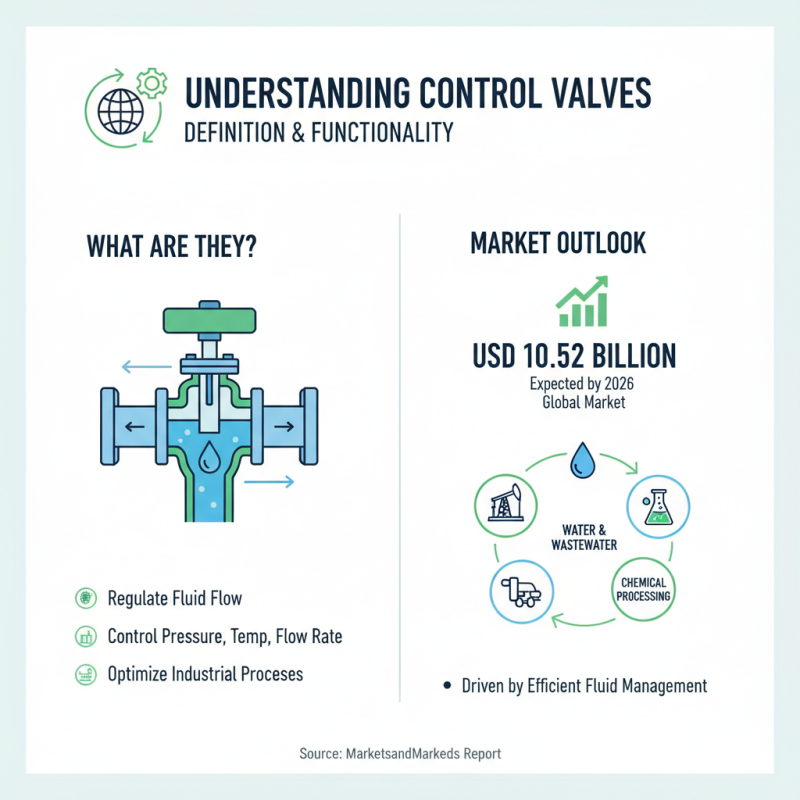
Understanding Control Valves: Definition and Functionality
Control valves play a critical role in regulating fluid flow within various systems. They control parameters such as pressure, temperature, and flow rate, ensuring optimal performance of industrial processes. According to a report by MarketsandMarkets, the global market for control valves is expected to reach USD 10.52 billion by 2026, driven by increasing demand for efficient fluid management solutions across sectors such as oil and gas, water and wastewater, and chemical processing.
These valves can be classified into several types, including globe, ball, and butterfly valves, each offering unique advantages. For example, globe valves provide precise flow control, while ball valves offer quick shut-off capabilities. However, the selection process can be daunting. Many facilities face challenges in choosing the right valve based on specific application needs. Research indicates that nearly 30% of control valve failures are due to improper sizing or selection, highlighting the importance of expertise in this area.
Proper maintenance of control valves is equally essential. Regular inspections can prevent leaks and failures, impacting overall system efficiency. Studies show that predictive maintenance can reduce downtime by up to 20%, emphasizing the need for a strategy focused on reliability. Understanding the function and significance of control valves is crucial for those involved in fluid management.
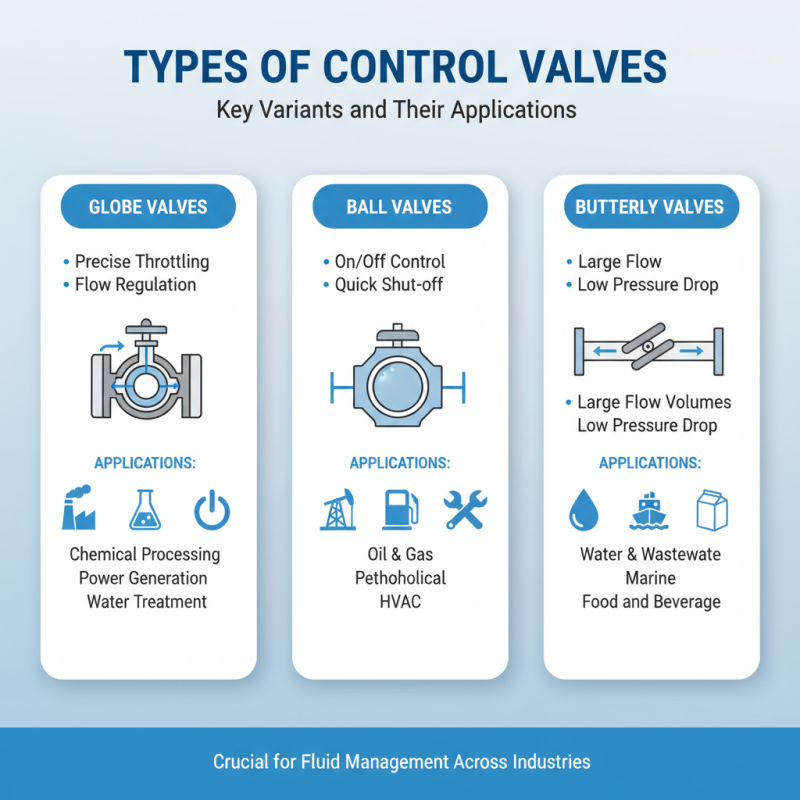
Types of Control Valves: Key Variants and Their Applications
Control valves play a crucial role in fluid management across various industries. Understanding their types and applications can significantly enhance operational efficiency. Among the most common types are globe valves, ball valves, and butterfly valves. Each serves distinct purposes, dictated by flow control requirements.
Globe valves are known for their excellent throttling capabilities. They suit applications where flow regulation is vital, such as in chemical processing. According to a recent industry report, globe valves can achieve flow control accuracy of up to 90%. Ball valves, on the other hand, provide quick shut-off capabilities. With a straightforward quarter-turn operation, they are often preferred in water systems, ensuring minimal fluid loss.
Butterfly valves offer a unique solution for large-volume flow control. Their design allows for rapid opening and closing, making them efficient for HVAC systems. However, they may struggle with precise flow modulation compared to globe valves. It’s essential to analyze specific project needs when selecting a valve type. Choosing the inappropriate valve can lead to inefficiencies or increased operational costs. Reliable industry data highlights that up to 30% of energy used in fluid systems comes from improper valve selection. This emphasizes the need for thoughtful decision-making in valve procurement.
Factors to Consider When Choosing Control Valves
When selecting control valves for fluid management, several key factors come into play. Understanding the nature of the fluid is essential. Is it corrosive or abrasive? These properties significantly impact valve material choices. For example, a highly corrosive fluid may require specific alloys or coatings to extend valve life.
Another important consideration is the flow characteristics necessary for your application. Different valves offer various flow rates and performance metrics. A valve’s flow coefficient, or Cv, defines how much flow it can handle. Knowing your system's requirements will help tailor your choice effectively.
Pressure and temperature ratings also shape your selection process. Ensure the valve can operate within the limits of your system. Many engineers overlook these critical specifications. This can lead to failures and costly downtime. Regular evaluation and adjustments based on system performance might be necessary. Thoughtful consideration of these factors can lead to enhanced efficiency and longevity in fluid management systems.
Best Control Valve Options for Efficient Fluid Management
| Valve Type |
Material |
Temperature Range |
Pressure Rating |
Applications |
| Ball Valve |
Stainless Steel |
-20°C to 150°C |
ANSI Class 150 |
Water, Oil, Gas |
| Globe Valve |
Brass |
-10°C to 200°C |
ANSI Class 300 |
Hot Water, Steam |
| Butterfly Valve |
PVC |
0°C to 60°C |
ANSI Class 150 |
Chemicals, Water Treatment |
| Check Valve |
Ductile Iron |
-30°C to 80°C |
ANSI Class 150 |
Pumping Systems |
Best Practices for Installation and Maintenance of Control Valves
Installing and maintaining control valves is crucial for efficient fluid management. Proper installation ensures the valve functions as intended, preventing leaks and pressure loss. Begin by following manufacturer specifications for positioning and orientation. Create a solid foundation for the valve to avoid misalignment. Check the alignment of pipes. Use proper supports to minimize vibrations, which can lead to wear over time.
Regular maintenance cannot be overlooked. Conduct routine inspections to identify wear or corrosion. Replace worn components timely to maintain performance. Utilize appropriate cleaning agents during maintenance to avoid damaging seals or internals. Observe operational conditions closely. Changes in pressure or flow may indicate underlying issues. Document all maintenance activities. This ensures a reliable history of the valve's performance and helps in future troubleshooting.
Training staff on control valve handling is essential. Knowledge about operating procedures aids in preventing mishaps. Encourage team members to report any irregularities promptly. This promotes proactive maintenance and a culture of safety. Inadequate attention to these practices can lead to inefficiencies and costly downtime. Reflecting on past experiences can reveal areas for improvement, ensuring a more robust fluid management system.
Emerging Technologies in Control Valve Systems for Efficiency
The evolution of control valve systems is pivotal for enhancing fluid management efficiency. Industries are increasingly adopting smart control valves, integrating Internet of Things (IoT) technologies. In doing so, they can monitor and control fluid dynamics in real-time. A recent report from the International Society of Automation highlights that these advanced systems can reduce energy consumption by up to 25%.
Moreover, predictive maintenance has become a game-changer. Sensors embedded in control valves provide data on performance and wear. This data allows for timely interventions, minimizing unexpected downtimes. Research from the Flow Control Association indicates that predictive maintenance can extend valve life by 40%. However, the integration of these technologies can be challenging and costly, requiring careful consideration.
Emerging materials also play a critical role. Lightweight, corrosion-resistant materials enhance the longevity of valves. They improve flow efficiency, ultimately leading to lower operational costs. Nonetheless, the selection of materials needs to balance cost and performance. Advances in manufacturing techniques have lowered production costs, yet some industries still rely on traditional options. A shift in mindset is essential for wider adoption of these innovative solutions.
Best Control Valve Options for Efficient Fluid Management
This chart illustrates the efficiency rating of various control valve types based on their performance in fluid management. The data reflects the efficiency percentage achieved by each valve type in industrial applications.